Thread
"Thread" would seem to be a fairly simple matter in the manufacture of shoes,
especially during the Medieval period, but this turns out not to be the case. From Roman
times about the 10th century, the "thread" shoes were made fromn was either flax
(or linen) for closing, or assembling, the uppers; and leather strips (such as
"thong", "wang"/whang", sinew, gut and so forth) for making, or
attaching the uppers to the soles. During the early medieval period (the Dark Ages)
some of the people of Britain seem to have used the leather strips for assembling uppers
as well. Around the 10th century, a transition to linen thread began to take hold
regarding making the shoes.. It should be noted that some woolen thread was used
about the 11th century. [Hald; MacGregor, p.138 and 140; Pritchard, p.219; O. Goubitz, private communication to D.A.
Saguto (Jul 1999); I. Carlisle, private communication to M Carlson (1998); email to
Medieval-Leather (1 Jul 1999); C van Driel, private communication to M. Carlson (19 Jul
99)]. After that waxed flax or linen thread gradually became more common, and after
the 14th century was eventually exclusively used, as far as we can tell. Currently, of
course, thread comes in all manner of different materials.
As with most aspects of shoemaking, there is a great deal of disagreement and confusion
about thread terminology, and rather than make the discussion at hand even more confusing
than it is already, the following terms will be used: Thread, or the
"thread" as it comes away from the spool or skein. Thread comes in plies, cords,
or strands, of three, four, five, six, seven, or eight individual Cords.
These cords may then also be made of thinner filaments (a "ply" for example is
made of 2 or more strands). Threads are sometimes numbered to indicate their size or
gauge, or referred to by their "weight" in Ounces. Most of the leather working
thread, waxed or unwaxed, comes in five or seven ply, while sewing thread is generally
either 3 or 6 cords.
- Prewaxed Thread
Some people are fussy about using pre-waxed linen threads. Personally, I think that for
most general work, this sort of thread is just fine, although I do understand why
most such purists would feel this way, and have the greatest respect for that. The
symmetrical, rope-like look created by pre-waxed thread goes away when you unwind and
remake it.
- Synthetic Thread
There are two forms of synthetic thread -- the good kind, that looks like "real"
thread and is quite strong, and the not-so-good kind that looks fake and tends to break
under the limited stress of sewing *I* place them under (weakling that I am). Even the
"good" kind has some problems; although the worst of these, slippage, can be
helped by rubbing them down with Shoemaker's wax. If you can't
tell the difference between the synthetics, and real linen thread, you are just going to
have to take someone's word for whether or not there is a real difference between the two.
I think there is, but in the end, you do what works for you.
- Cotton Thread
Conversely, don't feel bad about using cotton thread sold in fabric stores. Just get the
heaviest gauge available. We're going to show you how to work with it and strengthen it.
It can be strengthened in the thread making process, treating the cotton
threads as already separated threads.
- Linen Thread
Linen thread (or more specifically "Flax" thread) is a bast, or stem, fiber,
and, when spun, comes in a variety of different formats, waxed and unwaxed, tightly spun
and counterspun and hardly spun at all. Specifically, the term "linen"
refers to fabric or thread made from the flax plant. If you can find it, hand shoe
thread is probably the best thing to use. If you can't find it, linen thread is made
for use both by the hand sewing people and leatherworkers. Hand sewing thread
(available from the occasional sewing store (ask for linen or flax thread), or from some
re-enacting sutlers (Like J. Townsend and Sons). Leatherworking thread (available
from leatherworking craft stores and leather suppliers) comes in plies from three to
eight threads, although some comes in a single large ply that you make up to size. Thread
is sometimes numbered to indicate its size or gauge. They might also be referred to by
their "ounce". I believe that 2 oz. thread is the basic single strand. The
threads can be combined into thicker cords or separated into thinner or finer threads.
Plain white or beige is best for historical recreation work. Unwaxed thread must be pulled
through a cake of beeswax or Shoemaker's wax or Hand wax. A term
for this process is "Cereing" the thread.
- Hemp Thread
Hemp thread, like flax thread, is a bast, or stem, fiber thread - in this case, made from
the stems of cannabis sativa. There are historical references to shoes made with
hemp thread, and to a type of linen (sometimes called a "hempen linens").
While at one time, hemp thread was considered superior for this, probably because it is
more resistant to rotting, the majority of the thread you can get today as
"hemp" thread has failed to impress me. As for whether it was used in the
Middle Ages, I don't know of any research that's determined that the "linen"
threads found might have been hemp rather than flax, but it's entirely possible that it
was used for shoes.
- Wool Thread
Ok, my first thought when hearing about wool thread was that it was ridiculous to use,
because it breaks so easily. However, it can be spun tightly enough to use for thread
(although you may have to spin it yourself for that). The best things I can find SHORT of
learning to spin the woolen thread myself are a form of wool thread used for darning
socks, or unweaving a bit of worsted cloth. It can be strengthened in the thread
making process, theating the woolen threads as already separated threads.
- Artificial sinew
The use of artificial sinew is debated among some historical recreators, from the fact
that the cords are sometimes too strong for the leather and will cut through it (a
criticism I have also heard made about cotton, the synthetic threads. To be honest, I
don't know. I have never seen it happen to anything I've made), to the fact that
artificial sinew is not authentic for Medieval shoemaking. On the other hand, finding
sources for real sinew is quite difficult, and since I have never used it, I am
unqualified to just the merits of the real material. Artificial sinew can be separated
into its individual strands in a process called unwinding the ply, as with the linen
threads.
- This is the process by which one lays up individual threads, and binds them together
larger numbers of thread into larger ply threads.
- Method 1:
- Pull out a length of thread. By holding it firmly, in one hand it can be unravelled by
rubbing it along the leg (pushing your hand over the thread away from you). This takes
practice and patience. This will separate the thread into its individual strands.
- It is also possible to separate the threads by soaking them in water for a few moments.
They will come apart much more easily, and, individually, will dry in moments. Among other
things, this process will limit the kink in the thread, leaving it more under your control
when you rewind it.
- Rather than cutting the thread, the single linen strands can be further unwound
(n.b.these inner plies will probably be wound in the opposite direction of the full
thread) until with a gentle tugging they can be separated (I personally prefer to use
scissors, but this is one of those traditional things).
- Try and make all your lengths of thread the same (which REALLY takes practice if you are
tugging the threads, rather than cutting them)
- If you separate them properly, you can wind up with a very thin end, called a
"taw", on each thread.
- Keep this up until you have the desired number of threads.
- Method 2: [Shown to me by D.A. Saguto. It's not provably medieval, but it's
interesting.]
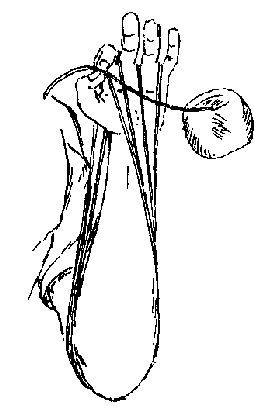
- Start by pinching a strand of thread between your index finger and your thumb.
- Hold this tightly.
- Bring the spool down, below your elbow and back up, to draw the thread around and
between the index finger and forefinger, repeat the process so that you have thread around
your elbow and between your fingers.
- When you have completed this hand, you should have a single strand, traditionally one
and a half fathoms (or 7 1/2 to 9 feet, depending on when your definition of
"Fathom" comes from (4 x 2x arm length; in my case, so my arm length from elbow
to knuckle is about 14 1/2 inches, so for me this strand is about 9 2/3s feet long)).
- Repeat the entire proceedure as many times as you want strands to ply together into your
thread. The more strands, the stronger the thread. Unfortunately, the more strands, the
thicker the final thread, also.
- Finally, clip the loop a bit in front of the thumb and forefinger holding the thread,
and a small bit of thread should fall away. Carefully remove the thread still connected to
the spool. It doesn't really matter if the thread is cut before or behind the
fingers holding it, but doing it this way leaves the thread in position for the next
portion of this trick...
- I am not going to get into a discussion of what threads were "waxed" with
right here. For that, see Code. You may take it as an article of
faith that, just as people today "wax" their threads before making shoes
(Shoemakers Wax), or doing any sort of leatherwork (usually beeswax), the threads are
coated in some sticky, gummy material, it is believed that as long as thread has been used
to work with leather, that thread was coated in something. This coating is there,
depending on who you ask, to protect the threads, to help lock them together when sewing,
help them stay together when winding, to lubricate their movement through the leather, and
so on. Note that even waxing synthetic threads, can be a good idea, since the waxed
threads will stick together better, making them easier to work with.
- Method 1: Either unwind the strands in a length of thread, or begin with a number
of individual threads. The threads should be should be stacked with their ends spaced
about a half inch apart. Separate these and holding them separately run them through the
cake of "wax", forming a waxed ribbon. Rolled the waxed ribbon into a round
thread, by rubbing it along the thigh (or over your leather apron, so that you can escape
getting any wax on your clothes) with one hand (pulling your hand over the thread
towards you), while holding the end sightly tense in the other hand. Wrap the rolled
thread around the hand that was holding the end, as you continue to roll the ribbon every
three inches or so. You should manage about 15-20 twists per inch (Note that if you can't
get that many twists per inch, don't sweat it, it will work with fewer).
You will notice that this system is neither neat and tidy, nor is it consistant,
with some threads wrapped loosely, while others are twisted much tighter.
- Method 2: To be honest, there is an easy way of doing this, one which many lazy
re-enactors appear to do. Find a thread that is a size you like, and rub the entire thread
through your "wax". Unless you have a need for a specially sized thread, or want
some extra protection for the thread (for example to help the thread resist rotting), no
one but you is likely to ever notice.
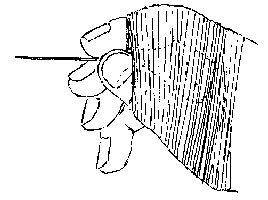
- Method 3 [Shown to me by D.A. Saguto. Again, it's not provably medieval,
 but
it's interesting, and if done properly, will be more regular than method 1, above] :
You should be holding several threads between your thumb and index finger, with a lot more
threads falling down behind them. Taking the extra thread, start wrapping it around
the thumb and forefinger (it doesn't matter whether you wind the thread counter clockwise
(although this will, I believe, produce a Z twist), or clockwise (producing, I believe, an
S twist)
but
it's interesting, and if done properly, will be more regular than method 1, above] :
You should be holding several threads between your thumb and index finger, with a lot more
threads falling down behind them. Taking the extra thread, start wrapping it around
the thumb and forefinger (it doesn't matter whether you wind the thread counter clockwise
(although this will, I believe, produce a Z twist), or clockwise (producing, I believe, an
S twist)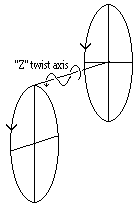 as long as you are consistant. This thread should be loosely wrapped, and
should not be overlapped by any thread that comes after it. When you are finished,
take the thread from between the index finger and thumb and pull gently. As you pull
the thread straight away from your hand, along it's axis, the thread will assume a slight
twist to it. This is a good thing. Rub the thread over the wax as you do this,
a few inches at a time. Wrap the thread around something (like your hand)
perpendicular to the axis of the thread: Then, without untwisting the thread,
repeat the process, as often as you need to. This will give you an even twist
through out the entire length of the thread.
as long as you are consistant. This thread should be loosely wrapped, and
should not be overlapped by any thread that comes after it. When you are finished,
take the thread from between the index finger and thumb and pull gently. As you pull
the thread straight away from your hand, along it's axis, the thread will assume a slight
twist to it. This is a good thing. Rub the thread over the wax as you do this,
a few inches at a time. Wrap the thread around something (like your hand)
perpendicular to the axis of the thread: Then, without untwisting the thread,
repeat the process, as often as you need to. This will give you an even twist
through out the entire length of the thread.
This is where we start treading into a difficult area that has caused me no end
of trouble in dealing with the more religious shoe traditionalists. So let me start
by saying that shoe tradition states that hand made shoes are always made, and generally
closed with bristled thread. Since tradition is a very poor basis for making
assertions, particularly when even today not everyone who makes hand made shoes uses
bristles, I have been exploring the history of using bristles. The details of this
exploration can be found here. The high point is that, at this
time, bristles can be documented at least as early about 1220 and were commonly enough to
have been referred to in France and Germany.
However, the difficult part of this is that prior to about 1000, when thonging was used
to make the shoe, to attach the uppers to the soles, bristles are unlikely to have been
used for that purpose. They may not have been used to close the uppers in this way,
since I am not at all certain that bristles can be attached to thonging. Thonging
suggests to me that some form of needle might have been used at this point.
Faceted needles, such as those known as "glovers needles" have been found at
least in London, and are shown in Egan's Medieval Household. Shoemaker's
needles are referred to later on in Juliana Berners' (b. 1388) alleged work,
"Treatise on angling" in the Boke of Saint Albans, where they are
suggested for making fishhooks. Needles are mentioned in both Thomas Dekker's
"The Shoemaker's Holiday" (1598) or Thomas Deloney's The Gentle Craft (1599)
and later. It can be assumed that these are related to the much later
"carrelet", used for whipstitching in linings in uppers.

A Carrelet. Unlike a glover's needle, the blade edges are sharp.
Boar's Bristle is used because it is flexible enough to make it ideal for some of the
tight curves needed for some of the stitches referred to. Any form of flexible material
is, theoretically, usable (as long as it is thin, stiffish, and durable and cheaper than
needles.
To begin with, you must use some form of sticky Shoemaker's Wax/Hand
Wax (which is often black, brown, green or gold, depending on the mixture), since
bee's wax will not hold the thread to the bristle. The wax is warmed in the hand and
fingers and then rubbed on the taw, or the long tapered end of the thread, and on the
Bristle.
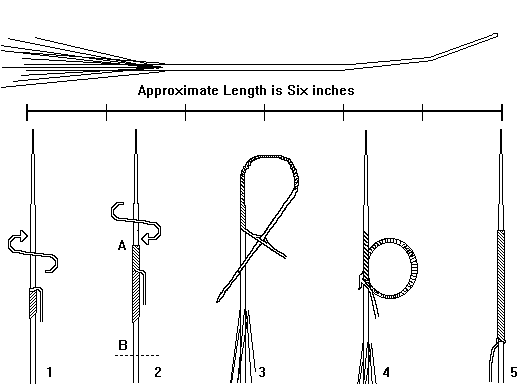
- Tightly wrap the thread upwards towards the point, beginning at about the middle of the
Bristle.
- After wrapping the thread about half an inch (to Point A), reverse the direction of the
thread so that you are now tightly winding back down the other direction (to Point B).
- After spreading the strands of the thread apart, turn the point of the Bristle back
through through the thread.
Pull the Bristle through the thread.
- Keep pulling the bristle through.
- Pull the bristle through until it reaches the hole in the thread. This should lock the
thread into place, along the body of the Bristle.
- Rub the bristle and thread down with beeswax, to cover the shoemaker's wax.
There are other techniques as well, including one described by Frommer that is more
closely akin to braiding the waxed thread and bristle than what has been described above.
Other items used as bristles are: Floss threaders; nine inch length of cheap
monofilament fishing line, even allegedly human hair for very fine stitching (as fine as
64 stitches to the inch, if you believe that).
Some people have suggested that all sewing and stitching can be done needles, and, in
all honesty, I have worked with these myself. What is important to remember is that when
working with all but the thinnest leathers you should be piercing holes for the stitches
with an awl rather than with the needle. This is not strictly true for glover's needles,
which have their awl-point as part of the needle, and these may be used in the place of a
"carrelet" in sewing the uppers. As a note for the pedantic, a carrelet
has a square sectioned needle, while a glover's needle has a triangular section.
Needles are often gauged with zeroes through higher digits to indicate size. You should
find a package of large and package of medium size needles sufficient to last you for
quite some time. I have not found the leatherworking needles found in fabric and sewing
stores to be durable to work with, but there opinions vary.
With some careful bending, harness needles can be bent sufficiently for use with curved
awls. Both Stohlman and Saguto say that harnessmakers have only begun to use harness
needles fairly recently (since the 19th century), and before that they used bristles as
well.
There are several methods for threading the needle that I have seen, the most simple
being shown here:
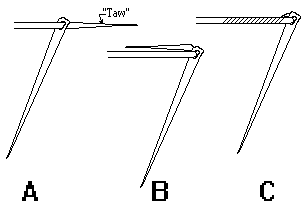
The thread is wrapped back around the thread to hold it firmly in place. The second
method, involves running the needle through the "tail" of the thread that
has passed through the needle, after tightly twisting the end of the tail. The thread is
pulled back while the needle is held firmly. If this is done properly, the needle will be
"locked" into place.
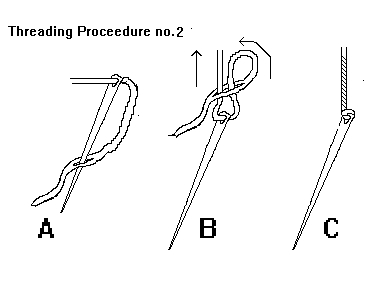
The third method, starts by taking the thread and twisting it about an inch and a half
from the end. Poke the needle through the thread twice, and then thread the needle. Pull
the thread over itself and the eye of the needle. This method will also lock the needle in
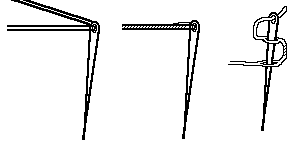
place. There is a fourth method that begins by threading the needle, and pulling the
thread through so that it can be pulled to two even lengths with the needle in the middle.
Then unravel the cords and rewind them into a single cord, with the needle sealed in place
at the end.
A common misconception among leatherworkers is that the waxed thread sold in leather
stores needs a rotary hole puncher and a big fat lacing needle to get it through a gaping
hole made by the punch. Moreover, that punched holes were generally slammed home with a
hammer and chisel-like tool. Neither of these is true for shoemaking. Stitching holes are
made by an awl, which is run through the leather, by hand. Then the thread is pulled
through by a bristle or needle (There is also a tool known as a "stitching awl"
(or a "lock stitch awl", that mimics a sewing machine's lock stitch, and while
some people are very fond of them I have never used one and so I am not able to describe
either the tool's virtues or failings. They are not a medieval tool, and I have
found no shoemaking tradition that uses them).
Ideally, stitching should be done with both hands, and an awl in the dominant hand,
never letting any of them down between stitches (personally, I can't manage this, but I
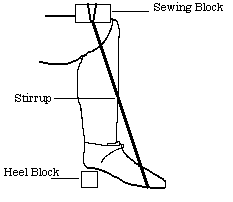
know it can be done). As long as I'm at it, just a note on posture. The
Traditional shoemaking posture is for the shoemaker sitting on a low work bench, with his
project on one knee, held in place by a stirrup, a closing or sewing block (if the item is
not lasted), with the heel resting on a heel, or footing, block. The sewing takes
place between the split portion of the stirrup, which is holding the work in place by
pressure on the heel block. In the few drawings we have of medieval shoemakers (see,
for example, the pictures in the Shoemakers section) this does
not appear to be the posture used, rather they sat on a normal height chair and held their
work up in front of them. Of the two, the former is purported to be the
ergonomically more sound.
Some people suggest that you try not to stitch with thread lengths longer than two
feet, while others use threads of an arm's span. A standard among shoemakers, according to
D.A. Saguoto is 1 1/2 fathoms (again, 7 1/2 feet to 9 feet, depending on when your
definition of "fathom" comes from). There is a major disagreement
between people (in this case, specifically between Saguto and myself) regarding the length
of thread you should use. If I may, the basic positions are:
- Pro-Long Thread: If you use the long thread, you do not have weak places, or thick
spots where threads end, or are doubled up. It looks neater, and more professional.
Also, knots hurt. A fathom and a half should be sufficient to completely go around the
shoe, and someone who knows what they are doing should be able to keep the thread lengths
from getting tangled.
- Pro-Short Thread: You're better off with short lengths of thread and overlapping
your stitching by a few threads. If your thread gives out, your whole seam won't go with
it and of course you will lose a lot of time trying to untangle long lengths of thread.
You will have a better control over the amoung of thread you use (although it can be
argued that the amount of thread lost in overlapping stitches is about the same as that
lost in tieing off of loose ends).
You don't need to shove your awl in too deeply, making a huge hole. Get the feel of
pushing it just deep enough to make a hole large enough let the thread pass snugly
through. (If you are using a needle, most professionals feel that you should never have to
use pincers or pliers, but that if the hole is too small, you should back the needle out
and use the awl to make the hole a little larger. Bristles, I'm told, don't
jam. Pincers, on the other hand, can break your needles).
When piercing the hole, the line of the stitching should be straight and even,
regardless of the sort of awl you are using. The idea is to get the thread to pull
across the width of the awl hole because it gets to grab more leather.
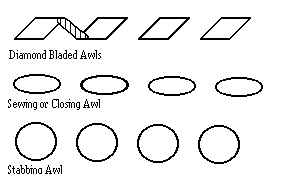
The diamond bladed awl appears to have been used at least in York in shoemaking.
Some 19th c shoemakers were reputed to make extremely fine stitches, specifically on
the uppers. The legendary extreme to prove the superiority of hand stitching to machines
is "64 to the Inch". As a comparison, the modern shoes I am currently wearing
have 10 stitches to the inch on the uppers, and 5 to the inch on the welt seam. Many of
the archaeological examples use stitches, especially to connect the soles to the uppers,
about 8mm or half a "finger" in measurement. Personally, for assembly work on
the uppers (including setting reinforcement cords and putting the pieces together) I use a
single or double ply thread and about 10-12 stitches to the inch. The modern sewing
machine can manage, at best about 30 stitches to the inch. More than that on a machine
will tear the leather. Work that is as fine as the 64 to the inch must have been done with
an extremely fine awl and a bristle of human hair.
- Historically, it seems that a single strand of thread was usually used, perhaps
unwinding it from a spindle, but more likely from a ball held in a covered cup with the
thread drawn through a hole in the lid, and then made up to size.
- A Scot's term for thread is Lingel. D.A. Saguto suggests that this is related to
an Old French term "Lingule" for a made up, waxed thread, however, this term has
not yet turned up in this meaning in my research.
- It should be noted that the salt in salt water can be highly corrosive to stitching, the
thread rotting and beginning to break within about a week. Wet linen will eventually rot.
However, coating the linen in pine pitch and resin will protect it both from water
and micro-organisms such that threads can still be found in centuries old undersea
archaeological sites.
Return to Contents
Footwear of the Middle Ages - Thread, Copyright � 1996, 1999, 2001 I. Marc
Carlson.
This page is given for the free exchange of information, provided the author's name is
included in all future revisions, and no money change hands, other than as expressed in
the Copyright Page.