Making Some post-Medieval Construction Shoes
Revised 23 August 2004
The obvious question that you should be having is why does this guy have a
section on making post-medieval shoes in a work on medieval shoes. Simply because
these shoes make their appearance at the end of the Middle Ages, and I get a
large number of requests for information about how to make them.
The non-turned shoe first appeared in the late 15th century (tradition places
this in Germany around 1480), probably when some shoemaker figured out that with
a few changes in the placement of the welt, he could make a shoe on a last right side out in the first place,
which would mean that he didn't need to turn them, and that this would open up
all sorts of options for heavier leathers, and so on. Or maybe some
apprentice was just bored, who knows. Current expert opinion holds that
the concept developed from the making of types of pattens (trippes, overshoes),
in which the leather that came down over the side of the soles was sewn in place
in this fashion. In any case, this technology
spread fairly quickly, pushing the turned shoe aside, and by the middle of the
16th century relegating turn shoes to dance shoes, children's shoes, servants shoes, and
other types of less durable and less expensive footwear.
When I first posted this page, I was fairly inexperienced with non-turned
shoes (frequently called "welted shoes" from the mistaken impression that
medieval shoes didn't have welts). I'm still no great expert - there are plenty
of folks who know a lot more about this than I do -- but I think I can give you a
pretty good idea of how to make them.
I am indebted to Al Saguto, David Martinez, D.W.
Frommer, and the nice folks at the Honorable Cordwainers Company (http://www.hcc.org/) for what little knowledge I do have. If this
work is
inaccurate in any way, the fault is mine and not theirs.
For more information,
see
http://www.personal.utulsa.edu/~marc-carlson/histshoe/index.htm,
specifically the material under
"Cordwainers." In
Dennis De Coetlogon's
An Universal History of Arts and Sciences
... and
John F. Rees' The art and mystery of a cordwainer.
- The principle differences between making non-turned shoes and making turned
shoes is that your uppers go on to the last with the outside on the outside
(which will be either be the flesh or the grain side depending on the period
and style of shoe you are making), and the welt is placed outside the upper,
instead of between the upper and the insole.
- First, you need a Last (yes, it is possible to do this without one, but it
is much easier to make a good product with one), or possibly two lasts - one
right and one left, depending on the style of shoe you are making, and the
century you are working with).
- Close your uppers (i.e.. Assemble the pieces of the
upper)
- Wet your insole completely. Set it aside to dry.
- Tack on your insole (traditionally this is done at the toe, the waist and
the heel. Hammer it close to take on any specific shaping from the
bottom of the last, and to mark the edge of the last into the insole.
Note: a technique used by West End London bootmakers is to cut the insole
oversize and tack it to the sides of the last. This allows a much better
shaping of the insole to the bottom of the last after the insole has dried
completely.
- Let the insole dry completely before you trim it to the edge of the last.
As it
dries it will continue to shrink slightly and you can wind up under-cutting
the sole size without meaning to. Note, if you mean to undercut the
sole's size that's fine (it is correct for many sorts of shoes over the
centuries to undercut the sole by 1/4 inch from the edge of the last), but you
really want to do that when you mean to, and not just to whatever the leather
may or may not shrink to.
- Cut the insole to the last. At this point, you need to shape the insole in whatever way is appropriate
to the shoe you are making. Early shoes require virtually no shaping at
this point - just holing them around. Some of your options include the
following:

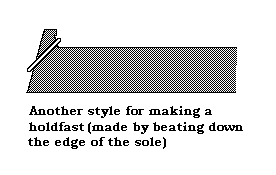
Cross sections of a variety of channeled/riggoted/rabbited/grooved insoles (15th century to
19th century)

Insole placement options.
- At this point, if you are using an older style insole placement, or have
undercut your insoles, you want to wet your insoles enough to hole
them: that is to say, to go around the edge making the holes you are going to
need to attach the upper to the insole.
- Soak your upper in water until the leather is fully saturated. Let it dry
enough to be fully malleable, but still damp.
- Place a tack in the center heel (A in fig. "Step 1")

- Pull the center of the toe as far over the toe of the last as you can, then
place a tack at point B

- Pulling the leather around the toe area smooth, tack it in the order shown
(C,D,etc)

- Remove the tack from point A, and then pull the heel section down into
place. This should be fairly tight, and will help pull the leather down flat
to the last to remove any bridging or gapping. Place a tack at K.

- Pulling the leather tight, tack around the rest of the sole area.

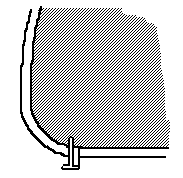
- Let this dry. Or, if you'd like, start slicking the upper at this
point: that is rubbing the leather down with a smooth stick or bone.
- When the upper is dry you may begin the Sewing, or Inseaming using the
holes you already made in the Insole. You will want to attach the welt at this
time. While you are sewing, you will want to make a half cast stitch
(creating a half hitch knot) by slipping the bristle traveling insole to welt
through a loop of thread traveling from the welt to the insole. This
places the knot on the weaker welt side of the seam to give it strength.
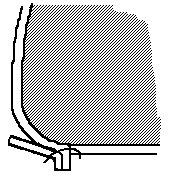
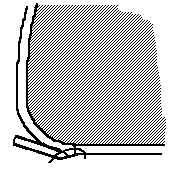
- Trim the excess leather from the seam and, wetting the seam, flatten it by
gently tapping with a hammer, then slicken it by rubbing it with a smooth
stick such as the hammer's handle..
- You may or may not want to prepare a bottom filling to help make a flat surface
for the sole. The filling may be leather scraps pasted down, cork, tar
covered thick felt, and such. If you are not going for total accuracy, contact cement is
a good way to secure the filling.
If you are going to attach a heel, you will want to attach the shank to the
waist at this time.
- Take the leather you are going to use for your outer sole and heel lifts,
and soak them completely. Take the leather out and dry it. When it is nearly dry, but not quite, beat it out (that is, take it and
hammer it while it is in this nearly dried state, to compress it and make it
harder. Start in the middle of each piece of leather and slowly work
your way out all around, since the leather will be spreading as you are doing
this. This will harden the leather, and change it so that it will last
longer.
- Set the outer sole in place. Again, if you are not going for total
accuracy contact cement is good for this as it will help eliminate squeaking,
and give a more solid attachment to the sole than simply stitching it on..
- Stitch the outer sole to the welt. Stitch as close to the body of the work
as you can but do not let your stitching cross your sewing.
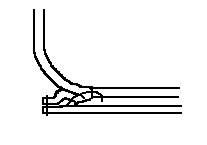
You may want to consider channeling (or making a riggot, rabbit, groove) your outer
sole so that the thread lies beneath the surface of the leather.
- Slicken the sole until it shines.
- If you are planning on attaching a heel, do so now. Men's heels are traditionally stacked layers of leather while
women's heels have traditionally been carved wood, often covered in leather or
fabric before the outer sole is attached (held on by the cover and the sole).
- Perform any other finishing work you think the shoe needs.
- Remove the shoe from the last.
According to professional bootmaker D.W. Frommer:
"This is Inseaming, a modern term that refers to attaching the welt,
vamp, vamp liner, counter and counter cover to the insole; literally, "to seam
in the insole". The insole is channeled, that is a rabbet (or
groove) is cut into the edge of the insole, and another inside channel
is cut parallel to, but interior to the edge. The leather sandwiched between
these two channels is called the holdfast. A curved awl is driven
through the holdfast in what amounts to a tunnel stitch, beginning in the
inside channel and emerging on the outside feather, or outside channel.
The awl further pierces the vamp and vamp lining and also the edge of the
welting. The bristles are fed into the resulting hole from opposing directions
and the first stitch is set, usually with a saddler's lock in a running
stitch.
According to Master Cordwainer D.A. Saguto:
"From c.1600, well into the 19thc., and even the 20th into the 21st., the
treatment of the insole edge and the architecture of forming the holdfast
for inseaming took various forms for shoes and boots made right-side out
with a welt, rand, or covered heel. The earliest two identifiable types of
holdfasts for these constructions occur in archaeological examples in great
numbers: 1) the plain insole, in which the leather is thick enough to sew at
the edge with a split-hold, the awl entering the flesh and exiting through
the cut edge; 2) a folded variant, where the insole leather was not thick or
strong enough to sew in the former manner, but bent up all along the edge into
a right-angle "L" shape, the inseam stabbing straight through the up-turned
ridge to create the holdfast. In order for the holdfast, and subsequently the inseam
itself, to be located far enough under the last bottom so the welt [or rand]
was positioned correctly, these two type of insoles were usually made
somewhat smaller all around the bottom of the last. By the
mid-to-late1600s, after lasts had universally developed sharp featherlines
defining the edge of the last bottom, these insoles were intentionally
under-cut smaller than the last's bottom shape (Garsault describes this as
cutting two notches at the heel breast, then trimming the insole around that
much smaller than the last bottom--the heel-seat was left full width).By roughly 1725-30 a third type of insole begins to be found, with an
extended "feather" [use your illustration], or sloping bevel of leather
outboard to the holdfast itself, which ended flush with the defined edge of
the last's featherline, but keeping the holdfast and inseam still well
underneath the last. This innovation of the "feather" increased in
frequency by the mid-1700s, especially on men's strong work. Though all
three types are found concurrently, after circa 1750, insoles with
"feathers" dominate the archaeological record except in women's work with
forepart rands. By circa 1810-25 the insole "feather" had all but displaced
the two former types (Rees decries them in 1813 in favor of the "feather"),
though there are references suggesting some shoemakers still persisted
making the under-cut forms as late as the 1860s."
Return to Contents or [Next]
Footwear of the Middle Ages - Making Some post-Medieval Construction Shoes, by I. Marc Carlson.
Copyright 1999, 2004.
This page is given for the free exchange of information, provided the author's name is
included in all future revisions, and no money change hands, other than as expressed in
the Copyright Page.